






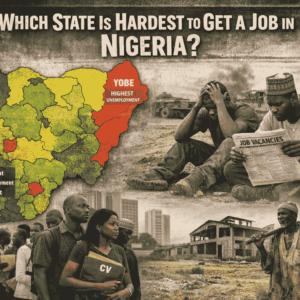
Finding a job in Nigeria is not just about qualifications, it is also about location. Many Nigerians ask the same pressing question every year: which state is hardest to get a job in Nigeria? This question matters because where you live can determine your access to industries, networks, infrastructure, and even information about job openings.
In this in-depth article, we answer the question which state is hardest to get a job using economic structure, unemployment trends, infrastructure gaps, security concerns, and lived realities of job seekers. This is not guesswork. It is a carefully reasoned, human-centred analysis written for students, graduates, artisans, professionals, and policy observers.
By the end, you will clearly understand which state is hardest to get a job, why it is so difficult, and what you can do if you live there or plan to relocate.
Understanding Job Difficulty in Nigeria: What Does “Hardest” Really Mean?
Before identifying which state is hardest to get a job, we must define what “hardest” means in the Nigerian context.
Key Factors That Determine Job Difficulty
A state becomes extremely difficult for employment when:
- Formal jobs are scarce or almost non-existent
- The economy is heavily dependent on subsistence agriculture
- Private sector investment is weak
- Security challenges discourage businesses
- Infrastructure such as roads, power, and internet is poor
- Government employment is saturated or politicised
When these factors combine, even qualified graduates struggle for years without stable work. This is the reality behind the question which state is hardest to get a job.
Nigeria’s Employment Landscape: A Quick Overview
Nigeria’s job market is uneven. States like Lagos, Rivers, and the FCT attract industries, while others rely almost entirely on civil service and farming.
Urban vs Rural Employment Gap
Urban states benefit from:
- Corporate offices
- Manufacturing hubs
- Tech ecosystems
- Media and creative industries
Rural and semi-urban states suffer from:
- Limited private sector presence
- Overdependence on government payroll
- Seasonal agriculture with low income
This imbalance explains why Nigerians keep asking which state is hardest to get a job.
Yobe State: The Widely Regarded Answer
When the question which state is hardest to get a job is asked across Nigeria, one name consistently comes up: Yobe State.
Why Yobe State Ranks as the Hardest State to Get a Job
Yobe State faces a rare combination of challenges that severely restrict employment opportunities.
1. Limited Economic Base
Yobe’s economy is dominated by:
- Subsistence farming
- Small-scale trading
- Government employment
There are very few:
- Manufacturing firms
- Large private companies
- Industrial parks
This means job seekers depend heavily on the state government, which cannot absorb everyone.
2. Long-Term Security Challenges
For over a decade, insecurity in the North-East has:
- Discouraged investors
- Forced businesses to shut down
- Reduced tourism and commerce
Security uncertainty makes companies avoid long-term investments, worsening job scarcity.
3. Weak Private Sector Presence
Unlike Lagos or Ogun, Yobe lacks:
- Tech hubs
- Industrial estates
- Financial service clusters
As a result, graduates often migrate after NYSC because staying back means unemployment.
For these reasons, many analysts conclude that Yobe State is the hardest state to get a job in Nigeria.
Zamfara State: Jobs Lost to Insecurity
Another strong contender when asking which state is hardest to get a job is Zamfara State.
Why Zamfara Is Extremely Difficult for Job Seekers
- Persistent insecurity has crippled mining and agriculture
- Businesses shut down due to safety risks
- Informal jobs dominate, with very low income
Even skilled workers struggle to find stable employment, making Zamfara one of the hardest places to secure a job in Nigeria.
Taraba State: High Potential, Low Opportunities
Taraba State has natural resources and agricultural strength, yet job creation remains weak.
Why Taraba Still Ranks High on Job Difficulty
- Poor infrastructure limits industrial growth
- Agriculture remains largely non-mechanised
- Government jobs are highly competitive
Despite its beauty and resources, Taraba remains one of the states often mentioned when discussing which state is hardest to get a job.
Ebonyi State: The South-East Exception
Job difficulty is not limited to the North.
Why Ebonyi State Struggles with Employment
- Minimal industrialisation
- Heavy reliance on civil service
- Limited private investment
Many youths migrate to Lagos, Anambra, or Abuja in search of opportunities. For residents who cannot relocate, Ebonyi can feel like the answer to which state is hardest to get a job in the South-East.
Comparing Job Difficulty Across Nigerian Regions
| Region | Job Difficulty Level | Key Reasons |
|---|---|---|
| North-East | Very High | Insecurity, weak private sector |
| North-West | High | Security issues, limited industries |
| South-East | Moderate–High | Few industries, migration pressure |
| South-South | Moderate | Oil dependency |
| South-West | Low | Industrial and tech growth |
This table explains why Yobe State still stands out when Nigerians ask which state is hardest to get a job.
Why Lagos Is the Opposite of the Hardest State
It is useful to compare.
Why Lagos Rarely Comes Up in This Question
- Strong private sector
- Startups, media, manufacturing, fintech
- High competition but high opportunity
Lagos is hard to survive in, but not hard to find opportunities. This contrast reinforces why states like Yobe top the list when discussing which state is hardest to get a job.
How Job Difficulty Affects Youths and Graduates
In states where jobs are hardest to find:
- Graduates wait years after NYSC
- Underemployment becomes normal
- Youth migration increases
- Mental health challenges rise
Understanding which state is hardest to get a job is not just academic, it is personal and social.
What To Do If You Live in the Hardest State to Get a Job
If you live in a state like Yobe, Zamfara, or Ebonyi, all hope is not lost.
Practical Survival Strategies
- Learn remote and digital skills
- Explore online freelance platforms
- Consider relocation if possible
- Engage in scalable small businesses
- Use federal employment programmes
Location matters, but skills and adaptability matter too.
The Role of Government and Policy
States ranked as hardest for jobs need:
- Aggressive private sector incentives
- Security stabilisation
- Youth skill development programmes
- Infrastructure investment
Until these improve, Nigerians will keep asking which state is hardest to get a job.
Future Outlook: Will This Change?
Yes, but slowly.
If security improves and infrastructure develops, states like Yobe could gradually attract industries. However, as of today, the evidence still points to the same conclusion.
Final Answer: Which State Is Hardest to Get a Job in Nigeria?
Based on economic structure, security, private sector presence, and employment realities:
Yobe State is currently the hardest state to get a job in Nigeria.
Other states like Zamfara, Taraba, and Ebonyi follow closely, but Yobe consistently ranks at the top.
Conclusion
The question which state is hardest to get a job reveals deep regional inequalities in Nigeria’s economy. While some states thrive with industries and innovation, others struggle under insecurity, weak investment, and limited opportunities.
Understanding this reality helps individuals plan better, policymakers act smarter, and society push for balanced development.
Also Read: What Is the Full Meaning of CDs for Corpers? A Complete Guide for NYSC Members
Frequently Asked Questions (FAQs)
1. Which state is hardest to get a job in Nigeria right now?
Yobe State is widely regarded as the hardest state to get a job due to limited industries, insecurity, and weak private sector presence.
2. Is it impossible to get a job in Yobe State?
No, but opportunities are extremely limited and mostly concentrated in government and small-scale agriculture.
3. Should graduates relocate from states with few jobs?
If possible, relocation or remote work can significantly improve employment chances, especially for skilled youths.











+ There are no comments
Add yours