



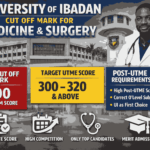



Choosing Medicine and Surgery as a course in Nigeria is not just an academic decision it is a life-defining commitment. Every year, thousands of brilliant Nigerian students sit for the Unified Tertiary Matriculation Examination (UTME) with one burning question in mind:
“What is the JAMB cut-off mark for Medicine and Surgery?”
This guide answers that question fully, clearly, and honestly. It goes beyond rumors and social media guesses to explain how cut-off marks work, what top universities really require, and how you can position yourself competitively even if your score is not perfect.
Understanding JAMB and Cut-Off Marks

The Joint Admissions and Matriculation Board (JAMB) is the official body responsible for conducting UTME and regulating admission into Nigerian universities, polytechnics, and colleges of education.
A cut-off mark is the minimum score a candidate must obtain to be eligible for admission consideration. However—and this is very important—meeting the cut-off mark does not guarantee admission, especially for competitive courses like Medicine and Surgery.
There are two types of cut-off marks:
- General (National) Cut-Off Mark – announced yearly by JAMB
- Departmental Cut-Off Mark – determined by each university
Medicine and Surgery relies heavily on departmental cut-off marks.
What Is Medicine and Surgery in Nigeria?
Medicine and Surgery (MBBS or MBChB) is a six-year professional degree designed to train doctors. After graduation, students undergo:
- One-year Housemanship
- One-year NYSC
- Optional residency training (specialization)
Because doctors are critical to national development, universities strictly regulate admission into Medicine and Surgery.
General JAMB Cut-Off Mark for Medicine and Surgery
JAMB does not set a single universal cut-off mark specifically for Medicine and Surgery. However, based on national admission standards:
The realistic JAMB score for Medicine and Surgery in Nigeria is between 250 and 300+.
Anything below 250 is considered unsafe, except in rare cases.
Why Medicine and Surgery Has the Highest Cut-Off Marks
Medicine and Surgery consistently has the highest cut-off mark because of:
- High competition (over 100,000 applicants yearly)
- Limited admission slots
- Professional accreditation requirements
- Cost of training medical students
- High academic demand
In many universities, only 50–150 students are admitted yearly for Medicine.
JAMB Cut-Off Mark for Medicine and Surgery by Universities
Let’s break it down clearly.
Federal Universities Cut-Off Marks
Federal universities are the most competitive.
Typical Range
- 270 – 320
Examples:
- University of Ibadan (UI): 300+
- University of Lagos (UNILAG): 280–300
- Obafemi Awolowo University (OAU): 280–300
- University of Nigeria, Nsukka (UNN): 270–290
- Ahmadu Bello University (ABU): 260–280
If you are targeting a federal university, aim for 290+.
State Universities Cut-Off Marks
State universities are slightly less competitive, but still demanding.
Typical Range
- 250 – 280
Examples include:
- Lagos State University (LASU)
- Delta State University (DELSU)
- Olabisi Onabanjo University (OOU)
- Benue State University (BSU)
A 260–270 score can be competitive here with a strong Post-UTME.
Private Universities Cut-Off Marks
Private universities are more flexible.
Typical Range
- 200 – 250
Examples:
- Babcock University
- Bowen University
- Afe Babalola University (ABUAD)
- Igbinedion University
Even with 220–240, admission is possible if you meet O’Level and interview requirements.
Post-UTME and Aggregate Score Explained
Your JAMB score alone is not enough.
Most universities calculate an aggregate score, such as:
(JAMB ÷ 8) + (Post-UTME ÷ 2)
Example:
- JAMB: 300 → 37.5
- Post-UTME: 80 → 40
- Aggregate = 77.5
Medicine usually requires:
- 70–85 aggregate score
Catchment Area, Quota, and Merit Factors
Admissions are divided into:
- Merit (45%)
- Catchment Area (35%)
- Educationally Less Developed States – ELDS (20%)
If your state is in the university’s catchment area, your required score may be slightly lower.
If You Score Below the Cut-Off Mark What Next?
All hope is not lost.
You can:
- Change institution to a private or state university
- Change course to Physiology, Anatomy, or Nursing
- Use JUPEB, IJMB, or Pre-Degree programs
- Re-sit UTME with better preparation
Strategic Tips to Secure Admission for Medicine and Surgery
✔ Aim for 300+ in JAMB
✔ Score 75%+ in Post-UTME
✔ Choose less competitive universities
✔ Ensure excellent O’Level results (A1–B2)
✔ Avoid wrong subject combinations
✔ Apply early and correctly
Common Myths About JAMB Cut-Off Marks
❌ “JAMB score alone gives admission”
❌ “Scoring 250 guarantees Medicine”
❌ “Private universities accept everyone”
✔ Admission is merit-based and competitive.
Conclusion
The JAMB cut-off mark for Medicine and Surgery in Nigeria is not fixed, but success depends on strategy, preparation, and realistic choices.
If you truly want Medicine and Surgery:
- Aim high
- Prepare smart
- Stay flexible
Medicine is demanding but with the right information, admission is achievable.
Also Read: JAMB Start Date 2026: Official UTME Commencement, Registration Timeline, and What Every Candidate
Frequently Asked Questions (FAQs)
1. Can I study Medicine and Surgery with 250 in JAMB?
Yes, but chances are slim in federal universities. State or private universities are more realistic.
2. What is the safest JAMB score for Medicine and Surgery?
290–300+ is considered safe nationwide.
3. Can I change course to Medicine after admission?
Highly unlikely. Medicine rarely accepts change-of-course candidates.









+ There are no comments
Add yours